Totally Exhaustion

Day 5, Saturday, June 29, 2019

We woke early and left camp at 6:15 long before the other. We’re hoping 45 miles today. That will leave us with less then 20 miles to on Sunday to hit Carmacks which is a big enough town to get groceries and a room for the night.

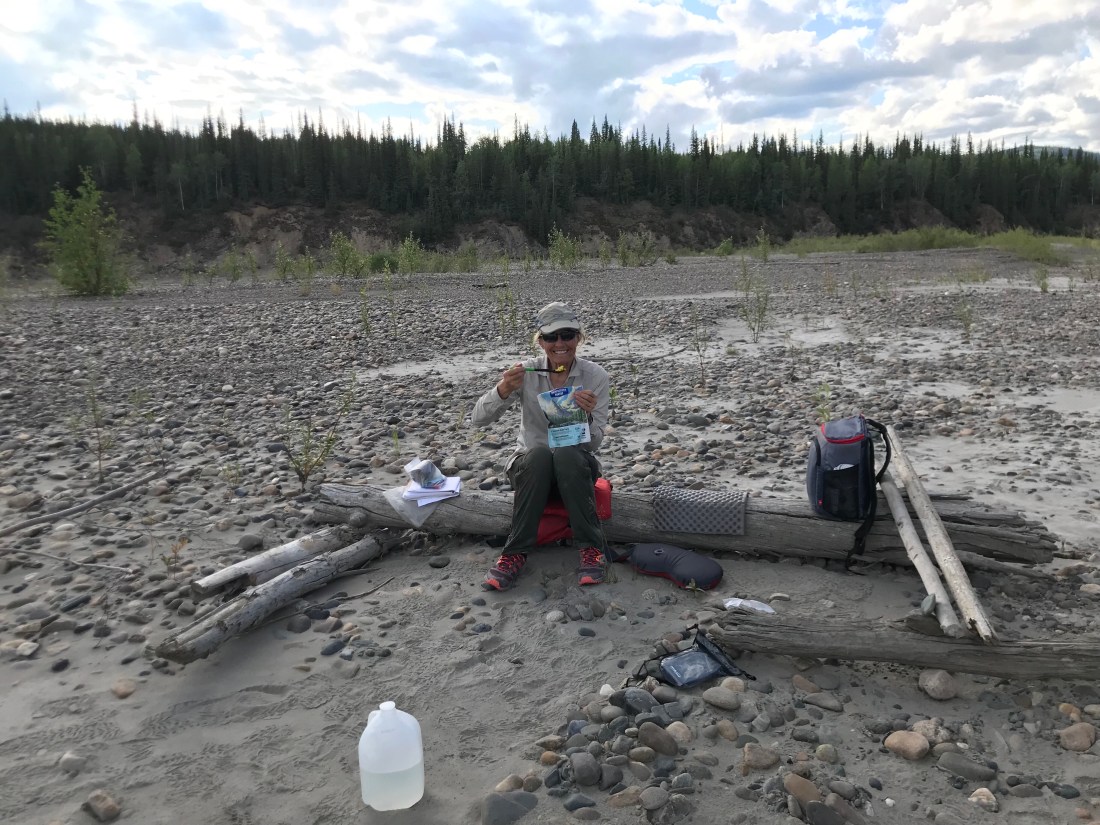
We’re ready for a shower and a chance to reorganize our stuff. Our food canister is 15 gallons about the size of a wine barrel. Everything falls to the bottom and gets lost. And our 30 gallon dry bag unfurls to be taller than I. We can’t see nor reach the bottom. Apparently what’s ever’s down there is not needed.

The morning was pleasant with few clouds just enough to keep us shaded. Both the river and our paddling seemed fast. And we had the river to ourselves.

About 11:00 we saw a group of paddlers pulling away from shore. They had five canoes and we heard them annoyingly chattering. Annoying because we don’t want to hear anything accept the sounds of the river. We worked hard to dump them, but they we’re paddling just a bit fast then we were. So we pulled off and let them go. We love our solitude.

Th wind picked up in the afternoon as did the heat. We beat into the wind for hours and by the time we stopped at four. We were trashed.

We saw Emma and Johnny, the people from Great Britain, on the shore so we stopped to talk. They were thinking of camp at this spot but decided to head to Carmacks to get some news. They hadn’t heard who their new prime minister was. We did not want to hear the news and spent the night. This was a night after five hard days of paddling that we could have used company. I just couldn’t stop whining about aches and pains and my 3 or 4 million mosquito bites.

Time to Move on

Saturday, July 6, 2019

Over breakfast we talk about climbing the Midnight Dome in town. But the sun is hot and getting hotter. We look at other choices. “Let’s just leave.”

We cancel hotel, get tickets on the Husky bus, pack and walk down to the bus office. By noon we’re headed for Whitehorse. Eighteen people on a twenty passenger bus. The road is paved but you wouldn’t know it, as we bumped down the road.

Dwarfed and twisted trees, their roots encased in permafrost, line the roadway and march off into the distance. Tiny tributaries eagerly pour their life into the mighty Yukon which grows by the mile.

I feel assaulted by this fast pace. We don’t lift a finger to propel down this hard unwelcoming surface.

There are no shoulders. Edges of pavement blurred by brazen plants encroaching on the earth that once belonged to them. The open window tunnel in hot, smoky air. We see a large billow of one of the fires off in a the distance, yet too near. Fireweed, Yukon’s territorial plant, blooms pink.

It seems the same at this pace. It could be in Florida or Maryland. Endless roads and gravel does feel quite right. Humans should ambulate under their own volition.

We started a conversation with two men, Carl and Toby who are just off the river. They are from England. They are both in the security business and met in Dubai where they both lived. They had been in the special forces in the military and now were using those skills.

They came to paddle the Yukon because of friends, one of whom has some celebrity. Their friends were raising money for PTSD by doing the entire length of the Yukon. They began by hiking the Chilkoot.

Ah ha, we remembered them. Dressed in black, both marched along at a speedy pace, not slowing for conversation with slower hikers., passing us near the summit. Left, right, left….. and they were gone. The next day at trail’s end on Bennett Lake, they switched to kayaks and started paddling. We know this because two 12 year old girls were carrying their packs, minus most of the gear to, to the train station where we were waiting. Later, from our chugging train, we spotted them on Bennett Lake at the ‘Entering Yukon Territory’ sign.

Leaving the River

July 5, 2019 (continued)

Packing our gear from water travel back to land takes a couple of hours. We want a shower, clean clothes, and a meal. Terry has nothing to wear while his clothes are being washed. It’s my job to wash the clothes. The machines are outside our room, it should be easy. But I don’t have enough loonies, the coin version of their dollar named after the loon on the coin.

The young woman at the desk, Lexie, is cheerful and conversational. She wears a blouse with a satiny sheen. The buttons are small and covered in the same fabric. It’s dressy especially for the 80 degree heat. I wanted to get five loonies and charge it to our incidentals. Lexie says, “Sure. No worries. I think I can do that.” She asks a coworker who says, “What do you think?”

A supervisor overheard and says no, no, no. I notice the super is wearing the same blouse and realize it’s a period costume representing the gold rush, that 2 year period of Dawson’s fame and existence over a hundred years ago. It’s the same in most of the gold rush towns. They cling to this period of greed and debacle.

Lexie sends me a few doors down to the bank. The young teller, Iris, starts into a story of her trips with her father to Whitehorse to buy supplies. Her sisters go too. It takes them seven hours one way. Her dad must drive slowly because of his medical condition. She loves to shop in Whitehorse it’s cheaper and there are so many choices. “It’s my father’s heart. The medical condition.”

“Where do you shop?” She asks me. “Lots of people here use Amazon.” She is piling and repiling the five coins. She sets them down like a dealer would. People are lining up behind me. She asks where I’m from. I tell her. She says she’s very sorry but now she’ll need to see my I.D.

Terry is wearing a towel in wait for me, and I haven’t even started the washer.

Two hours later, we head out for a late lunch/early dinner.

The room and the world up here has turned too hot and light for 10:00 pm, so we leave our bed for a walk. Teenagers hang out on the corners provoking adults by their very being. Drinkers spill into the streets to smoke. Cigarette smoke masks the smelling of the forest fires as the butts smolder in the dirt streets. Every third word is fuck in all of its forms: noun, verb, present, past, pluperfect, gerund and the hyphenated mother form.

We walk with disappointment because our rental car was picked up by the delinquent renters. The rental agent had no backbone and capitulated and let the other renter take the car. I’ve had a dream for years of traveling the Dempster to the arctic oceans. Now we’re stuck inside of Dawson with the Dempster blues again.

I’m glad to say good night to the streets of Dawson.

Stunned

Day 11, technically 10 days one hour from launch, Friday, July 5, 2019

I started off the day at 5:30 am saying I think we’ll make it to Dawson by 5:30 pm. The cut off time to return the boat is 6:00. I add that perhaps I’m off on our speed estimation. It could be tomorrow. I can’t recognize anything on the map. I keep saying I have no idea where we are. Fear of being lost drives us harder.

Then, strangely, a real house appears on the left sitting by itself. I use binoculars to look for a road. Terry spots one, but I say no that’s too big. We see a couple other signs of civilization. Then I see a scar on a hillside.

The scar

“Terry, that’s it, the scar from the brochure cover.” I pull out the brochure. It’s only 10:30 and we’re heading into Dawson. Terry is giddy. He’s saying totally silly, senseless stuff. I’m looking at the map (obviously we were off by about 30 miles) searching for directions on where to land. We are flabbergasted and thrilled as the paddlewheel tour boat approaches, tourists leaning over taking our pictures. This is what they saw. Hello Dawson!

Bear on Beaver Lodge

Day 10, July 4, 2019

Started at 6:00 am under calm overcast conditions perfect for paddling. The smoke was gone. Soon we spotted a lone trumpeter swan, then a red fox working the shoreline for sandpiper fledglings. A pair of beavers watched us slide by, then disappeared with a loud tail slap. Even a river otter stretched its neck higher for a look. The river is braided with islands and beaver dams. Lots of backwater and possibly a fish haven.

Navigator (Deb) was unsure of our location much of the day as landmarks were often obscured by the many islands (we speculated). We never saw any other paddlers yesterday, and none today. Deb wonders if we are on the wrong river. We paddle harder hoping for landmarks, almost missing a very black bear on a beaver lodge. We paddled close and were shouting at him hoping for a showstopper photo. The bear totally ignored us as he was systematically dismantling the lodge. We could not linger to see the end result as the river’s pull is not long denied. Judging by his determination, it seemed he has tasted success previously.

Just before lunch, a moose cow and calf swam the river in front of us and blended into the willows.

White River joined us from the left and everything was changed. The load of silt was unbelievable. Instead of seeing rocks on the bottom, the Yukon became totally opaque, resembling boiling mud pots in Yellowstone. Grit ground loudly against the canoe bottom. How do salmon swim through this?

We camped on a sediment bar with no bugs and a nice breeze.

Barges on the Yukon

Day 9, Wednesday, July 3

Not a mammal all day. Ravens walked the shoreline and two Bohemian Waxwings flitted in the poplars, but the wind and smoke, possibly from the fire near Dawson City, seem to have kept the animals hunkered down. Winds of 15-20 mph nearly stall us. Looking for faster water, we stayed mid-channel. Today was work.

Barges were busy in this section of river. One passed us going downriver and two going upriver loaded with porta-potties, various containers, and a tracked MOG.

Our camping goal was a meadow near Coffee Creek. As we approached, a small cargo plane crossed over, banking hard for landing, just as a helicopter buzzed upriver with a sense of urgency. Ten minutes later the chopper returned and landed near the cargo plane. It appeared to us like a medivac operation was in progress, but the scene was obscured by trees.

Nearby, a gold dredge was tethered to the bank near a painted sign proclaiming KAMINAK GOLD MINE. We could hear a turbine-like whine of what Terry speculated was a gold centrifuge. Since the mining operation had taken over the meadow, we set up camp just past the creek and listened to the helicopters frequent excursions. Valuable cargo? The creek appeared to have been bombed, but it was just the work of gold hungry humans using the dredging tool. If you have never seen a modern one, they are basically a floating hoover sucking everything off the bottom. Rocks of a certain size are spit out into piles and smaller stuff is kept for the stamper (crusher). The final step is sorting out the gold from the paydirt. Dredges can wreak havoc on a river system, so this mining operation had been stalled for years.

Two fellows working on a dredge near Carmacks said five of them pull $100,000 per month from the river, of which 15% goes to the dredge owner, and they split the remainder. Everybody was making a lot of money for pulling 5 pounds of gold from the river bottom!

Four on a Canoemaran

Day 8, July 2, 3019

We woke to our low marshy camp on a narrow island. It was a hot night. The smoke rolled in just before bedtime choking the clear woodsy air making visibility and breathing difficult. The morning was clear. Time was seamless without dark skies.

Just ahead, up the bluff, lay Fort Selkirk. We land our canoe, the art of which should be graceful by now but isn’t. We are next to a kayak and a wooden canoe attached to a red canoe by something that looks like a table. We climb up the hill and find a camp with many identical tents neatly organized. Fresh faced, fabulously fit young teens are attending some kind of camp.

A man about our age wearing a button-down shirt with a homemade neckerchief ring introduces himself and his buddy to us. They and two grown kids and their spouses are the owners of the boats on the beach. The daughter in her 40s said they slept late and now they have to make up time to make a connection. She was clearly not happy. We wondered if they had spent too much time gathered around the table between the canoes. The older men were much impressed with the restored village and encouraged us to spend some time there. We felt compelled by them to do so.

Fort Selkirk is a former trading post. There was a lot of convoluted history involving the Selkirk First Nations and the Hudson Bay Trading Company. The Klondike Highway passed the village by, leaving them frozen in time by isolation. The buildings from the mid 19th century were cared for with lots of love. It was sweet. After twenty minutes we had our fill.

The family was gone when we got back on the water. We liked the solitude, but hoped to see Jennifer and our British friends before day’s end.

After a short stop to stretch, we see boats nearing us. It’s a strange sight. Something appeared off. My binoculars revealed that one vessel was a kayak darting around this strange platform of a boat. As it neared we realized it was the two bound canoes. We thought the binding was for land use only. But here we had a canoemaran. This is used for stability. We surmised that the not-too-happy daughter and her husband were inexperienced and the dad and his friend devised this plan for the comfort of the couple. The other couple seemed to be accomplished kayakers. The graceful perfectly symmetrical canoes were now an embarrassed looking barge. When pointed straight down the current, they moved well. But with a wrong adjustment, the vessel ended up stalled out pathetically wishing to be untwined

They yelled to us that they were behind schedule and had to make up time. I’m late. I’m late for a very important date. Mad as a hatter and twice as twisted.

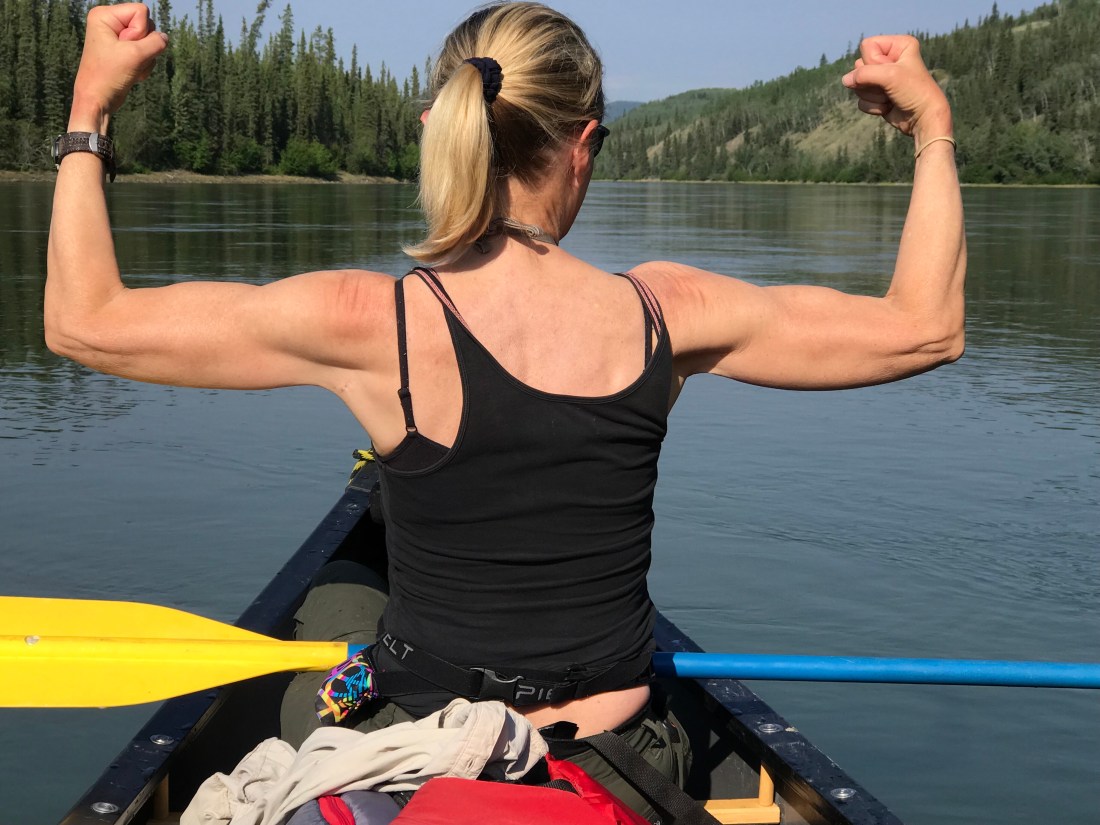
Have you ever played leap frog with mad hatter? Back and forth. Sideways and around. Until we broke free. Pulling our paddles furiously. They were never to be seen again. In fact this was the last time we’d see another paddler until Dawson.We paddled with strength and wisdom, if I may. The first twenty minutes of morning paddling is painful. We call out “switch” to each other for a change of sides, usually opposite sides. This mitigates some of the pain. Then we fall into our rhythm. We make tens of thousands of strokes a day. The paddles were heavy. Arms, muscles, joints and tendons scream, but the rhythm puts you in a daze of perpetual motion. It become you. Sounds are of flowing water, eagles high in trees, the call “switch.” There are no conversations nothing mechanical. When the one, of four barges in total, came up the river, we heard it for miles.

I looked closely at the map it had become hard for me to identify landmarks because we try to hug the shore to view animals. Close to the vegetation I got whiffs of something sweet waves of it passed. Then a large bull moose waded straight ahead. We slowed and lingered in the peace, grace and power. Close in like this we viewed the spotted sandpiper our ubiquitous dipper protecting its young by flying ahead. She exclaimed to us ” come my young are here and here and here not there” as it moved forward.

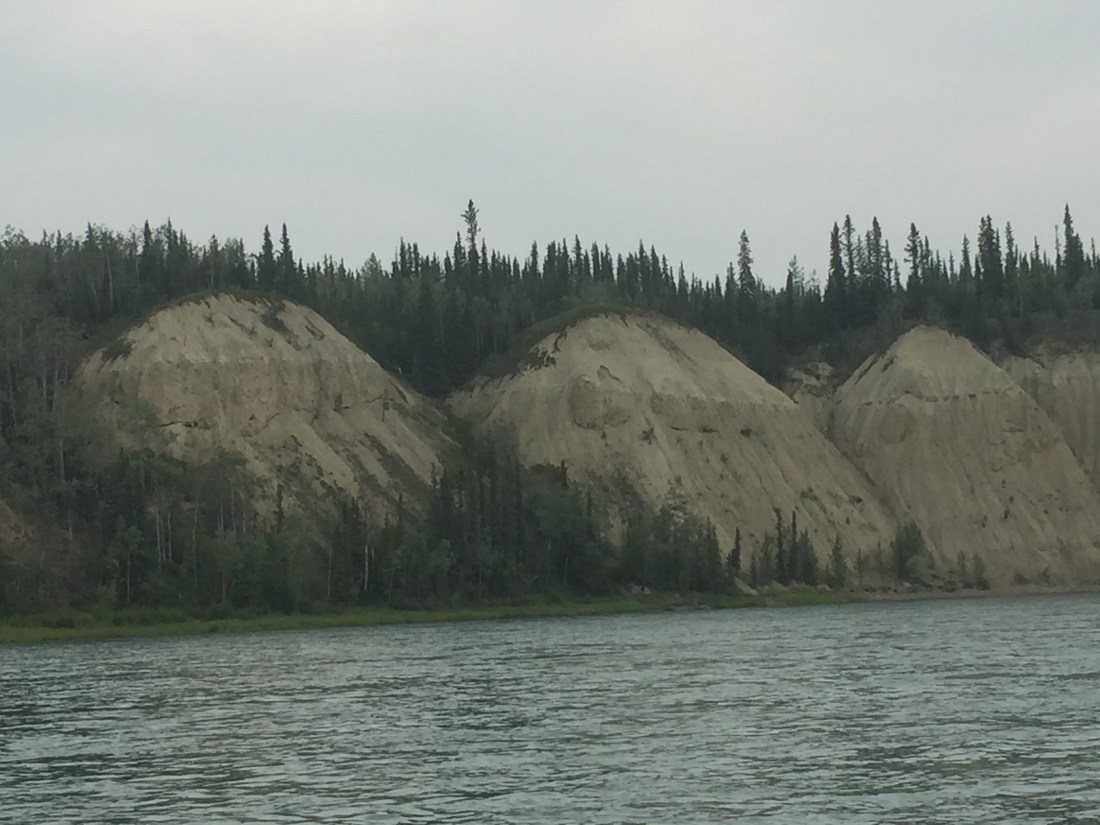
As it got late, we scoured the basalt cliffs for a good campsite that remained illusive. But a good site on gravel and sand worked out fine. Fifty-three miles. We basked in the pain and energy of a hard, hard day.

The site was packed silt, fine as talc. Terry poked around in the rock piles for jade. Tonight there were no bugs of any kind. Weird!!

The Day of the Rapids

Day 7, July 1, 2019

Have not seen friends from last night’s fireball party this morning yet as we push away from the campground landing. It is 7:00 am and Five Finger rapids is waiting about 35 miles downstream. The river is fast and clear and sweeps us along under the Carmacks bridge, one of only 3 bridges on the 1982 miles of Yukon waterway.

Up ahead on a sandbar is Jennifer’s red canoe. She is bent over doing something. As we pass by, she waves her gold pan and says, “I think I found a nugget”.

Soon, the towering rocks of Five Finger rapids come into focus. Our pulses quicken. Preferred passage is through the narrow channel on the right. Standing waves and eddies fight for space. Time speeds up and suddenly our canoe is being jerked in all directions. Water splashes off Deb in the front as the bow dips and then rises. Thirty seconds later, the danger is behind us. We celebrate our teamwork for keeping the canoe straight and the shiny side down. A sandbar allows us to beach and wait for Jennifer, who comes shooting through , whooping and raising her paddle. There is an overlook above the rapids that allows car people to spectate and record passage. Nothing to report this morning, except for about a gallon of foamy water in the canoe.

We paddle close to Jennifer for awhile. She seems pleased to be venturing alone. She says, “People pay for this solitude.” We paddle forward a bit. We hear her exclaim that she is at a low point. We wait for her. She says, “At times I think fuck it.” I think how can you? Where do you give up but at the end? There’s no where to put out. And there’s no cell service. She tells us her phone is dead and her charger is not working. Deb says, “Take mine it has two charges.” We hand it off to her. She asks if we’re going to stop at the abandoned cabin. Why not?

At mile 38 for the day we saw Jennifer’s canoe on the bank. We landed to inspect two gold rush era cabins with Jennifer. The log walls were still solid, though roofs were long gone. There was a Chevy pickup from about 1940 with many parts missing. The odometer showed 22,190. A Chevy truck of the same vintage and condition was located 1/4 mile away. There are no roads, so they must have been delivered by barge for purposes unknown.

Jennifer was excited to see this find. We were ready to move on and left her to eat her lunch. This turned out to be the last time we saw her.

An hour later we beached at a camping area with an active gold operation, it appeared. There were two cabins, one of which was old, but sound and clean inside. Trails went off in different directions. There was a large pile of bear scat, full of hair, not your typical vegetarian pile. It was a great campsite, until we remembered a guide back in Carmacks saying she would bring her large group here tonight. We reloaded our canoe and pushed off into the racing current and strong headwind, nearly capsizing for the first time. There were no other potential campsites listed on our map, so about an hour later we beached on the gravelly upriver side of a small island. Lots of flies, mosquitoes, and no-see-ums. Deb adds another hundred scratch points to her collection. She is going mad until neosporin and fireball work their magic. We have not seen Johnny and Emma all day and wonder if they had trouble in the rapids….

Halfway (almost) Carmacks 217 miles

Day 6, Sunday, June 30, 2019

We were almost to Carmacks when we saw a settlement of some sort. I fixed my binoculars on a sign and thought I could read Kanoe People. This is our canoe rental company. So we were watching carefully to figure out if we should be doing something when we saw two people waving at us. We realized it was our British Friends. We were on the opposite side crossing against the current.

When you paddle against the current it creates and optical illusion and stationary background physical features like mountains and islands appear to move. It makes me queasy. So I put my head down and paddled as hard as I could. We landed at a dock. This was a camp for paddlers. We were relieved to get a cabin. We walked to town for supples. We crossed a bridge over the Yukon one of only three in it’s 2000 mile length.

The town had one grocery store, a gas station, a hotel and a liquor store. Good enough. We bought a big bottle of Fireball Whiskey to replace the bottle we gave to the Taiwanese paddlers.

When we returned the Taiwan group had just arrived. They wanted a picture with me. Then Julian and Benedicta arrived. Every paddler we met was here. It was a lively night on our cabin deck with the couples and Fireball.

Our cabin at Coal Mine Campground in Carmacks

Near Disaster

Friday, June 28,2019

3:30 am: Terry left the tent to empty his bladder in the woods. It was overcast, but the sun’s pale early light was strong enough to cast shadows. He hears splashing at the water’s edge. A moose and two calves are just finding their footing after swimming across the Yukon, which at this point is flowing at about 5 mph. “Deb, moose”, Terry whispers. Above the roar of the river, mama moose hears this and herds her babies back into the river for another 100 yards of swimming. Adult moose swim with much of their head and neck out of the water. Very young moose are mostly legs, and though they are capable swimmers, they are not so buoyant. All that is visible above the water line is the nose, the eyes, and part of the ears.

Since we are paddling with the flow, we are on a more leisurely schedule, not breaking camp until 8:00 am. It seems so easy. If we sit in the canoe and keep it straight for 10 hours, we can make our required 40 miles per day. Reality is there are lots of rocks, eddies, snags, and gravel bars to avoid. And that requires constant paddling. Today we noticed 3 canoes very close together. Through the binoculars, Deb could see they were all using their hands to hold the canoes together like a raft. It seemed odd, then as we neared them, there were several screams and people started falling in the water. All three canoes overturned and six people were thrashing for their lives. Five of them held on to their canoes and tried to swim to the shore 20 feet away. Four made it and we were able to push the fifth with our canoe. The sixth person was riding a waterproof 15 gallon food barrel, circling the giant and powerful eddy that had capsized them. As we thought what to do, Deb said we are not going into that eddy. After about 10 minutes of flutter kicking the final person broke free and collapsed on the riverbank. They were all shivering. Deb fished out our emergency kit for them – emergency blanket, hand warmers, etc. They were from Taiwan and didn’t speak much English.We helped them empty their boats and retrieve their gear. Their gopro was ruined, along with one cell phone, and a couple of paddles and loose stuff had floated away. Their tent and much of their food was in another barrel still circling the eddy. Nobody was even thinking about going after it. They didn’t want any food from us, so Deb gave them her fireball whiskey. They were happy! Just as we were pushing off, the barrel was ejected from the eddy. We were able to intercept it about 50 feet downriver and drive it into a tree snag, leaving it for them. It really drove home how dangerous the river can be, and how difficult doing anything in a 5 mph current is.

We had another 15 miles to go, and were eager to make camp before the rain. Deb is the navigator and is getting pretty good at spotting the landmarks. Before long she spotted a red canoe pulled up on a bank and we aimed for it. There was no slack water, so the method is to turn the canoe upriver at the last possible moment, sliding into the bank. We missed by about 20 feet, but just like horseshoes, close also counts. Two Brits, Emma and Johnny, were sitting on the bank, enjoying a beer. They welcomed us and we were enjoying a nice conversation when the rain began. Quickly we set up the tent and jumped inside. Half an hour later, the sound of canoes on gravel broke the silence. It was the 6 overturned people and they were in good spirits. Must have been the fireball…. They were quick to pull all there gear up to the camp site and get to work drying it. We wanted to talk to them but they were busy and only one of them spoke English.